
Uncontested Divorce in Texas
The Uncontested Divorce Process in Texas: A Step-by-Step Guide for Collin County Residents

When you and your spouse reach the mutual decision to end your marriage and agree on how to handle your property, debts, and children, you do not need to endure a lengthy or contentious legal battle. In these situations, the Texas divorce process uncontested offers a streamlined, cost-effective, and dignified way to finalize your separation.
An uncontested divorce allows you to bypass the emotional strain and high costs of court hearings, mediation battles, and trial preparation. However, even when both parties agree on every detail, navigating the legal requirements of Texas family law can still feel daunting. A single mistake on a form or an improperly drafted decree can lead to costly delays or future legal headaches.
For couples living in McKinney, Frisco, Allen, and throughout Collin County, understanding the exact steps to file for divorce in texas will help ensure your uncontested divorce is completed quickly, correctly, and with complete legal protection. Below, we break down the requirements, the step-by-step procedure, and why having legal guidance remains essential—even in an amicable split.
What Qualifies as an Uncontested Divorce in Texas?
To utilize the Texas no contest divorce process, you and your spouse must be in 100% agreement on every single legal term of your divorce before filing or before submitting your final paperwork to the judge.
If there is disagreement over even a single detail, such as who keeps a specific vehicle, how a retirement account is divided, or what time school drop-offs occur, your divorce is considered contested, and those issues must be resolved before finalizing the case.
Key Requirements for an Uncontested Divorce:
- Complete Financial Agreement: Full consensus on dividing community assets, real estate, bank accounts, retirement funds, and personal belongings, as well as allocating all marital debts.
- Complete Agreement Regarding Children: If you have minor children together, complete agreement on conservatorship (custody), possession and access schedules (visitation), child support amounts, and medical support obligations.
- No Spousal Maintenance Disputes: Mutual agreement regarding whether spousal maintenance (alimony) will be paid, and if so, the exact amount and duration.
- Willingness to Sign Legal Documents: The non-filing spouse must be willing to sign a Waiver of Service and review and sign the final Final Decree of Divorce.
Residency Requirements Before You File
Before you can initiate the uncontested divorce process in Collin County, you must meet the Texas residency qualifications outlined in Texas Family Code Section 6.301:
- State Residency: Either you or your spouse must have lived in the state of Texas for at least six consecutive months prior to filing.
- County Residency: Either you or your spouse must have lived in the county where you plan to file (e.g., Collin County) for at least 90 days prior to filing.
If you meet these residency requirements, your case can be properly filed at the Collin County District Clerk’s office in McKinney.
Step-by-Step: The Uncontested Texas Divorce Process Timeline
While an uncontested divorce is significantly faster than a contested battle, Texas law still dictates specific procedural steps that must be followed.
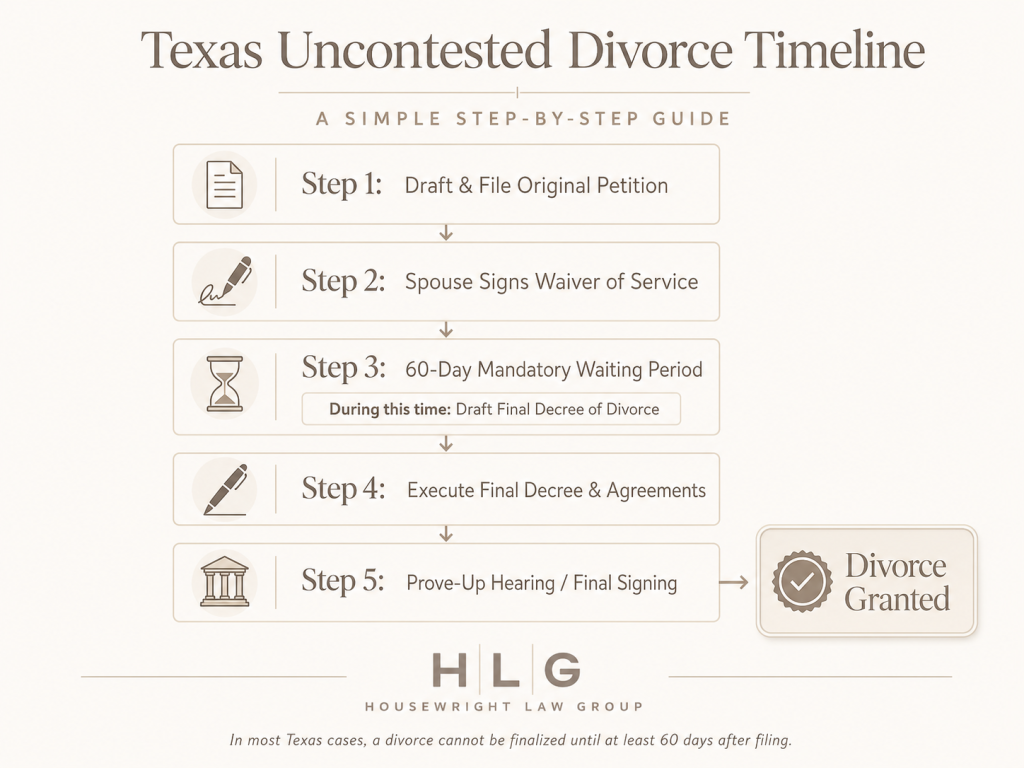
Step 1: Draft and File the Original Petition for Divorce
The process begins when one spouse (the Petitioner) files an Original Petition for Divorce with the Collin County District Clerk. This document officially initiates the lawsuit and identifies the parties, any minor children, and the general grounds for divorce (typically “insupportability,” which is the Texas equivalent of no-fault divorce).
Step 2: Provide Notice (Waiver of Service)
In a contested divorce, the non-filing spouse (the Respondent) must be formally served with court papers by a sheriff, constable, or private process server.
In an uncontested divorce, formal service is not necessary. Instead, the Respondent signs a Waiver of Service Only in the presence of a notary public. This document acknowledges receipt of the petition, waives the need for formal process servers, and signals to the court that the case will proceed cooperatively.
Step 3: Observe the Mandatory 60-Day Waiting Period
As required by Texas Family Code Section 6.702, Texas enforces a mandatory 60-day waiting period from the date the petition is filed before a divorce can be officially granted.
During this 60-day window, you and your attorney will draft the comprehensive Final Decree of Divorce. This detailed contract outlines every term of your agreement, including property schedules, debt assignments, and parenting plans.
Step 4: Review and Sign the Final Decree of Divorce
Once the Final Decree is drafted, both spouses review the document carefully. If both parties agree to every word, both the Petitioner and Respondent (and their respective legal counsel) sign the decree.
Step 5: The “Prove-Up” Hearing
Once the 60-day waiting period has elapsed and all documents are signed, the case can be presented to a Collin County judge. This brief proceeding is called a prove-up hearing.
During a prove-up, the Petitioner appears before the judge at the Collin County courthouse in McKinney (or in some instances, submits an affidavit if allowed by local rules) and answers a series of simple questions under oath to confirm:
- You meet the residency requirements.
- Your marriage has become insupportable.
- You have reached a fair agreement on property and children.
- Both parties signed the agreement voluntarily.
If everything is in order, the judge signs the Final Decree of Divorce, making the dissolution of your marriage official.
Common Pitfalls of “DIY” Uncontested Divorces
Because an uncontested divorce feels straightforward, many couples are tempted to use generic online form templates or attempt a “Do-It-Yourself” divorce. While this may seem like a way to save money, it often leads to serious financial and legal complications later.
Common risks of DIY uncontested divorces include:
- Ambiguous Custody Terms: Vague visitation or holiday schedules that lead to misunderstandings, parental conflict, and expensive post-divorce enforcement litigation.
- Improperly Divided Retirement Accounts: Failing to realize that dividing a 401(k) or pension requires a separate Qualified Domestic Relations Order (QDRO). Without a QDRO, transferring retirement funds can trigger massive tax penalties.
- Unresolved Real Estate Equity: Signing a decree that awards the marital home to one spouse without requiring a mortgage refinance or a Deed of Trust to Secure Assumption, leaving the other spouse legally liable for the debt.
- Omitted Property or Debt: Forgetting to explicitly allocate bank accounts, vehicle titles, or tax liabilities, leaving ownership in legal limbo after the divorce is closed.
Why You Still Need a McKinney Divorce Attorney for an Uncontested Divorce
Even in a non-contested divorce, your Final Decree is a binding legal contract that will dictate your financial obligations and parental rights for years ,or decades, to come. Working with a skilled attorney ensures that your agreements are enforceable, compliant with Texas law, and tailored to protect your future.
At Housewright Law Group, we help couples navigate the uncontested divorce process with efficiency and precision. An experienced McKinney divorce attorney from our firm can handle all drafting, court filings, and procedural requirements, allowing you to finalize your divorce cleanly without unnecessary stress or hidden surprises.
Whether you need an attorney to draft a customized Final Decree or review an agreement you and your spouse have prepared, we provide the authoritative guidance you need to move forward with confidence.
Ready to complete your uncontested divorce smoothly and securely? Contact Housewright Law Group today to schedule a confidential consultation at our McKinney office. Let us help you turn the page to your next chapter.