
Enforcing Your Divorce Decree in Texas
Enforcing Your Divorce Decree in Texas: Motion to Enforce and Contempt of Court in Collin County

Finalizing a divorce brings a long-awaited sense of closure. When the judge signs your Final Decree of Divorce, you expect both sides to honor the terms, follow the custody calendar, divide the accounts, and move forward.
Unfortunately, for many divorced individuals and parents across McKinney, Frisco, Plano, Prosper, and Celina, the ink on the decree is barely dry before their ex-spouse begins ignoring court orders.
Whether your former spouse has stopped paying court-ordered child support, repeatedly withheld scheduled possession of your children, refused to pay their half of uncovered medical expenses, or stalled on signing real estate deed transfers, you are not powerless. In Texas, a signed divorce decree is not an informal guideline or a polite suggestion, it is a binding final judgment issued by a district court with the full force of state law behind it.
When an ex-spouse willfully refuses to comply, filing a motion to enforce divorce decree Texas allows you to bring the matter back before a Collin County district judge to compel compliance and hold the violating party accountable.
Below, we explain how enforcement actions work in Texas, what remedies the court can impose, including jail time for contempt of court divorce Texas, and how to build an airtight enforcement case in McKinney.
Common Decree Violations Subject to Legal Enforcement
Texas family courts have broad authority to remedy non-compliance across financial, parental, and property provisions. The most common violations brought before Collin County judges fall into three main categories:
1. Child Support and Financial Support Violations
- Unpaid Child Support: Falling behind on monthly base child support obligations.
- Unreimbursed Medical and Dental Expenses: Failing to reimburse their 50% share of out-of-pocket healthcare costs (copays, deductibles, orthodontics, therapy) within the 30-day window required by standard Texas decrees.
- Lapsed Health Insurance: Canceling, dropping, or failing to maintain required health or dental coverage for the children.
- Unpaid Spousal Maintenance: Failing to make court-ordered monthly spousal support or contractual alimony payments.
2. Custody, Possession, and Access Violations
- Denial of Possession: Refusing to surrender the children for weekend, holiday, or extended summer possession under the Standard Possession Order (SPO) or custom parenting plan.
- Chronic Tardiness and Pick-Up Violations: Repeatedly arriving hours late or returning children prematurely without justification.
- Interference with Communication: Blocking scheduled telephone, FaceTime, or portal calls between the child and the other parent.
3. Property Division and Asset Transfer Stalls
- Refusal to Sign Real Estate Documents: Stalling on executing a Special Warranty Deed, Deed of Trust to Secure Assumption, or listing agreements to sell a Collin County marital residence.
- Retirement Division Delays: Refusing to cooperate with plan administrators or sign paperwork required to process a Qualified Domestic Relations Order (QDRO) dividing a 401(k) or pension.
- Failure to Deliver Property: Refusing to surrender vehicles, titled recreational assets, bank funds, or designated personal belongings awarded in the decree.
The Legal Process: Filing a Motion for Enforcement in Collin County
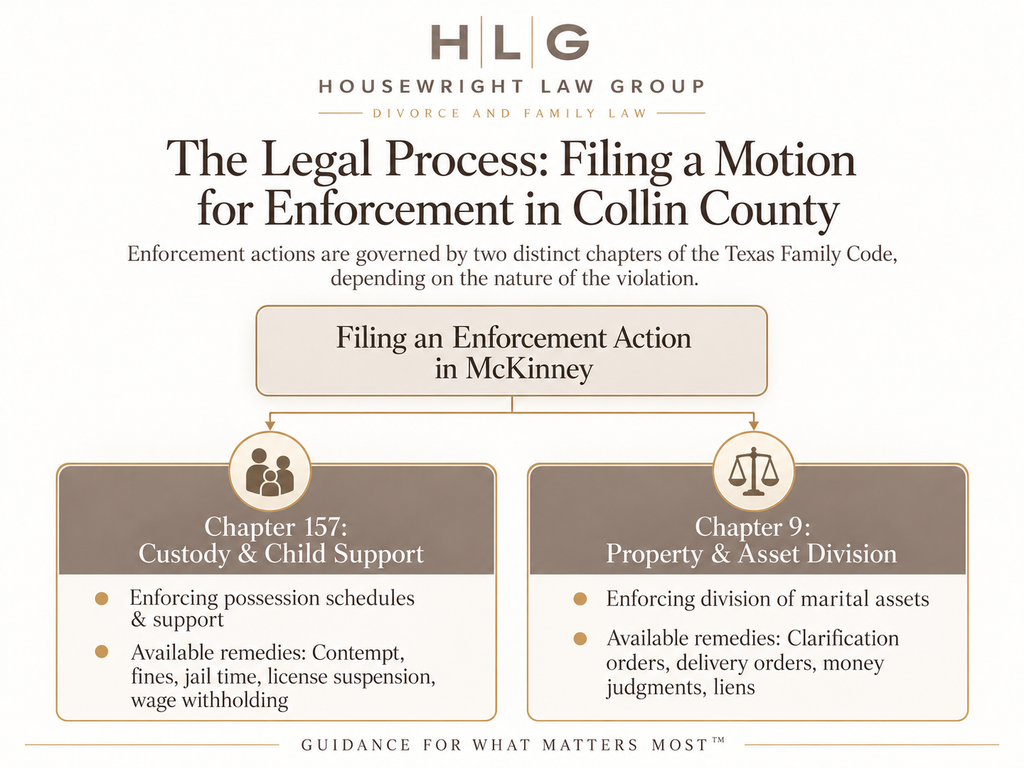
Enforcement actions are governed by two distinct chapters of the Texas Family Code, depending on the nature of the violation:
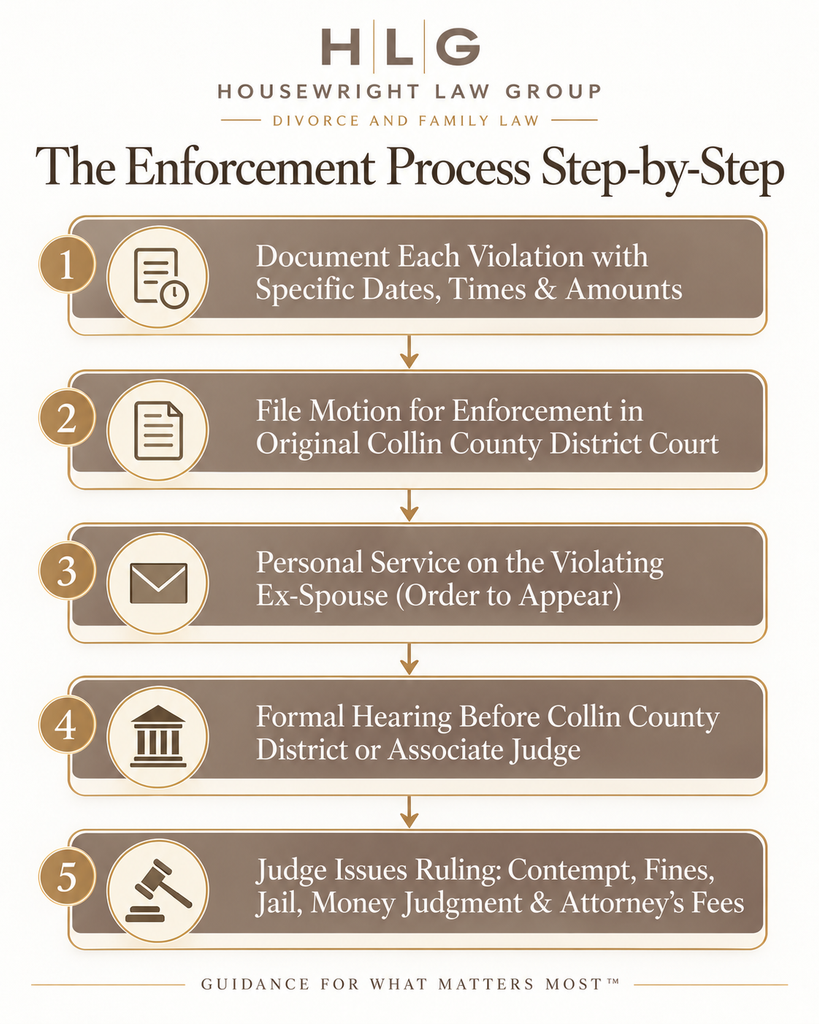
- Filing the Motion: Your attorney prepares and files a formal Motion for Enforcement in the Collin County district court of continuing, exclusive jurisdiction where your original decree was entered.
- Order to Appear & Personal Service: Because enforcement actions (especially those requesting jail time for contempt) carry quasi-criminal penalties, Texas law strictly requires personal service of citation on your ex-spouse along with an order commanding them to appear in court on a specific date. Service via standard mail or email is generally insufficient for contempt proceedings.
- The Court Hearing: At the hearing in McKinney, both parties present evidence and testimony. The moving party carries the burden of proving that the violation occurred and that the respondent had the ability to comply.
Remedies and Penalties: Contempt of Court in Texas
When a judge finds that an ex-spouse willfully disobeyed a lawful court order, the court has extensive statutory powers to enforce compliance and penalize misconduct.
1. Civil Contempt (Coercive Incarceration)
Civil contempt is designed to compel immediate compliance. The judge orders the violating party to jail until they perform the required act—such as paying a specific lump-sum cash amount toward delinquent child support (known as a “purge condition”) or signing a deed. In civil contempt, the violator carries the keys to their own jail cell; as soon as they comply with the purge condition, they are released.
2. Criminal Contempt (Punitive Jail Time)
Criminal contempt is designed to punish past willful non-compliance and maintain court authority. Under Texas Government Code § 21.002, a Collin County judge can sentence a non-compliant ex-spouse to up to 180 days in county jail per individual violation, and/or impose fines of up to $500 per violation. These sentences can run concurrently or consecutively.
3. Cumulative Money Judgments with 6% Interest
For unpaid child support, medical reimbursement debts, or property equalization funds, the court will calculate the total arrearage and enter a cumulative money judgment against the non-compliant spouse. Under Texas law, child support judgments automatically accrue 6% mandatory statutory annual interest until paid in full.
4. License Suspensions and Financial Liens
For parties who fail to pay child support, Texas Family Code Chapter 232 allows courts to suspend the violator’s:
- Texas driver’s license.
- Professional, commercial, and occupational licenses (e.g., medical, legal, contractor, real estate, accounting).
- State-issued hunting and fishing licenses.
Additionally, the court can issue liens against bank accounts, non-homestead real estate, and insurance settlements.
Property Division Enforcement: Clarification Orders and Turnover
When how to enforce divorce decree property division Texas is the central issue, Chapter 9 of the Texas Family Code governs.
While Texas law generally prohibits jail time for failing to pay simple contractual debts, the court has robust tools to enforce property distributions:
- Order of Delivery: Directing a party to turn over specific physical assets or funds by a date certain.
- Order of Clarification: If a decree’s property division term is deemed too vague or ambiguous to be enforced by contempt, the court can enter a clarifying order setting a specific timetable, location, and method for compliance.
- Money Judgments for Damaged or Disposed Property: If an ex-spouse intentionally disposed of, concealed, or damaged personal property awarded to you, the court can enter a money judgment for its full market value.
- Court-Appointed Receivers: If an ex-spouse refuses to list or sell a home in McKinney or Frisco as ordered, the judge can appoint an independent real estate receiver to take control of the property, sign closing documents, and distribute the net proceeds without the uncooperative spouse’s signature.
Mandatory Award of Attorney’s Fees in Texas Enforcement Cases
One of the greatest deterrents against violating a divorce decree is that Texas law strongly protects the complying party from bearing the financial cost of enforcement.
Under Texas Family Code § 157.167:
If the court finds that the respondent has failed to pay child support or violated a possession order without good cause, the judge must order the respondent to pay the movant’s reasonable attorney’s fees and all court costs.
In property division enforcement actions under Chapter 9, courts also possess statutory discretion to award reasonable attorney’s fees to the prevailing party.
The 4 Essential Elements Required for a Successful Enforcement Action
To secure a contempt finding or enforcement order before a Collin County district judge, your case must satisfy four strict legal requirements:
- A Clear, Specific, and Unambiguous Order: The decree must state exactly what the party was required to do, when they were required to do it, and where it was to be performed. Vague language like “parties shall reasonably split expenses” is difficult to enforce by contempt; exact language like “Respondent shall pay 50% within 30 days of receipt of written invoice” is easily enforceable.
- Willful Non-Compliance: You must demonstrate that the violation was intentional. The respondent may attempt to raise an affirmative defense (such as an inability to pay child support despite exhausting all reasonable efforts), which they must prove by a preponderance of the evidence.
- Detailed, Chronological Documentation: Maintain a strict paper trail. This includes bank statements showing non-payment, text/app messages documenting denied custody pickups, certified mail receipts, and copies of itemized medical bills delivered with written demand for payment.
- Proper Legal Service: The respondent must be personally served with the motion and notice of hearing in full accordance with Texas Rules of Civil Procedure.
Stand Up for Your Rights with an Experienced McKinney Divorce Lawyer
You spent time, emotional energy, and financial resources securing a fair divorce decree. You should not have to spend your post-divorce life begging your former spouse to follow the law or cover their court-ordered obligations.
At Housewright Law Group, we take a decisive, tactical approach to post-decree enforcement. Whether you need assistance enforcing child support order Texas statutes provide, compelling the turnover of marital property, or pursuing criminal contempt remedies against an uncooperative ex-spouse in Collin County district courts, an experienced McKinney divorce attorney from our team is ready to stand by your side.
We understand the local court rules at the Collin County courthouse in McKinney and know what it takes to present clear, undeniable evidence to local judges. Let us help you hold your former spouse accountable and restore the peace of mind you deserve.
Ready to enforce your court-ordered rights? Contact Housewright Law Group today to schedule a confidential consultation at our McKinney office. Let us help you take decisive action.