
Modifying Child Custody and Support Orders in Texas
Modifying Child Custody and Support Orders in Texas: When and How to Update Your Collin County Decree

When a court issues a final divorce decree or custody order, it reflects your family’s circumstances at that specific moment in time. However, life rarely remains static. As years pass, children grow older, parents change careers, families relocate, and financial situations shift. When your current parenting plan or child support terms no longer work, you may be wondering: Can a court order be changed in Texas?
The answer is yes.
Under Chapter 156 of the Texas Family Code, parents have the legal right to seek a child custody modification Texas when significant life events make existing arrangements unworkable or contrary to a child’s best interests.
For parents in McKinney, Frisco, Plano, and across Collin County, understanding the legal thresholds and procedural requirements is essential before heading back to court. Below, we break down how to modify child custody in Texas, what constitutes a legal change in circumstances, how to adjust child support, and why informal “handshake” agreements can put your parental rights at serious risk.
The Legal Standard: “Material and Substantial Change”
Texas courts place a high value on stability for children. Because judges do not want parents to re-open litigation over minor disagreements, Texas law sets a strict legal standard for modifying an existing order.
To modify conservatorship (custody), possession schedules (visitation), or child support, you must prove two fundamental elements:
- There has been a material and substantial change in circumstances in Texas regarding the child, a parent, or another party affected by the order since the date the previous order was rendered (or since the signing of a mediated settlement agreement).
- The proposed modification is in the best interest of the child.
What Qualifies as a Material and Substantial Change?
Texas statutes do not provide an exhaustive checklist of what qualifies as “material and substantial,” giving Collin County family court judges significant discretion. However, established Texas case law recognizes several common situations:
1. Significant Changes in Parental Circumstances
- Relocation: A parent moves outside the designated geographic restriction (e.g., outside Collin County or contiguous counties) due to career changes or remarriage.
- Severe Lifestyle or Household Changes: A parent’s new marriage, cohabitation with an unsuitable individual, or unsafe living conditions that negatively impact the child.
- Substance Abuse or Criminal Activity: Drug or alcohol addiction, criminal charges, or incidents of family violence that threaten the child’s physical or emotional safety.
- Medical or Mental Health Issues: A parent suffering a serious illness, disability, or mental health crisis that impairs their ability to care for the child.
2. Changes in the Child’s Needs and Age
- Growing Developmental & Educational Needs: As children transition into middle school, high school, competitive sports, or advanced academic programs, a schedule designed for a toddler may no longer be practical.
- Special Needs Diagnoses: The emergence of medical, psychological, or educational conditions requiring specialized treatment or care routines.
- Child’s Expressed Preference (Age 12 and Older): Under Texas Family Code Section 156.006, when a child reaches 12 years of age, either parent may request that the judge interview the child in chambers regarding their preference for which parent should have the exclusive right to designate their primary residence. While the judge is not strictly bound by the child’s wishes, their preference carries substantial weight.
The Step-by-Step Custody Modification Process in Collin County
Navigating a formal modification lawsuit involves several key legal steps:
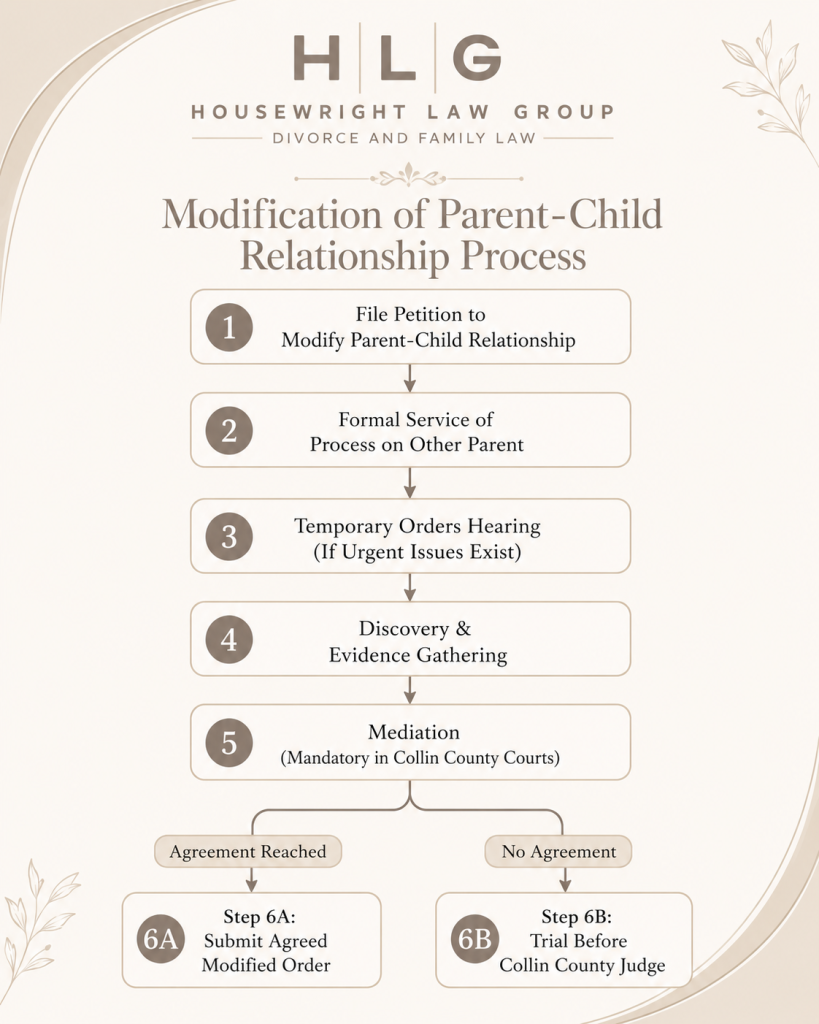
1. Filing the Petition to Modify (SAPCR)
The process begins by filing a Petition to Modify the Parent-Child Relationship in the court of continuing, exclusive jurisdiction—typically the Collin County District Court in McKinney that issued your original decree.
2. Service and Response
The other parent must be formally served with citation and a copy of the petition. They have until the Monday following the expiration of 20 days after service to file an official Answer.
3. Temporary Orders (When Immediate Relief is Needed)
If the modification involves urgent matters, such as severe parental neglect, impending school enrollment deadlines, or safety concerns, your attorney can request an emergency Temporary Orders hearing to establish ground rules while the lawsuit is pending.
4. Mandatory Mediation
Collin County district judges almost universally require parents to participate in alternative dispute resolution (mediation) before setting a modification case for a contested trial. If both parties can agree on updated terms, they will sign a binding Mediated Settlement Agreement (MSA).
Modifying Child Support in Texas
In addition to custody and visitation, parents frequently need assistance modifying child support in Texas. Under Texas Family Code Section 156.401, a court may modify an existing child support order under either of the following conditions:
- Material and Substantial Financial Change: A significant increase or decrease in either parent’s income (such as job loss, significant promotion, or permanent disability), a change in the child’s medical insurance costs, or an alteration in the physical possession schedule.
- The Three-Year Rule: It has been at least three years since the last child support order was rendered or modified, and the monthly amount ordered differs by either 20% or at least $100 from the amount that would be awarded under current Texas child support guidelines.
The Danger of Informal “Handshake” Agreements
When life changes, parents often try to handle things amicably by agreeing via text message, phone call, or email to change the visitation schedule or reduce monthly child support payments.
While cooperating is commendable, relying on informal agreements is extremely dangerous in Texas:
- Unenforceable in Court: An informal agreement does not legally modify a court order. If your ex-spouse suddenly decides to enforce the original decree, the court must follow the signed order on file, not your verbal understanding.
- Child Support Arrears Accumulate: If you informally agree to pay less child support, the legal difference continues to accrue as delinquent child support (arrears) under state records, complete with mandatory 6% annual statutory interest and potential license suspensions.
The only way to ensure an agreed change is legally binding and protective of both parties is to have an attorney draft a formal Agreed Order on Motion to Modify and submit it to a judge for signature.
Why You Need a McKinney Modification Attorney
Modification lawsuits require a strategic presentation of clear, documented evidence. Proving that a change in circumstances is both “material” and “substantial” requires thorough preparation, whether you are requesting an adjustment or defending against an unjustified modification claim.
An experienced McKinney divorce attorney from Housewright Law Group can help you:
- Evaluate your circumstances to determine if they meet Texas statutory modification thresholds.
- Gather documentation, school records, medical evaluations, and financial statements to build a compelling case.
- Represent your interests during Collin County mediation and contested court hearings.
- Draft precise, legally enforceable modified decrees that protect your parental relationship.
At Housewright Law Group, we understand that families evolve. We are committed to helping parents throughout McKinney, Frisco, and Collin County navigate custody and support modifications with empathy, integrity, and decisive legal advocacy.
Has your family’s situation changed? Contact Housewright Law Group today to schedule a confidential consultation at our McKinney office. Let us help you update your court orders to reflect your family’s current needs.