
How Is Child Support Calculated in Texas?
How Is Child Support Calculated in Texas? Guidelines, Caps, and Collin County Rules

When parents separate or divorce, ensuring that their children remain financially secure and supported is a primary concern. Whether you anticipate paying child support (as the obligor) or receiving it (as the obligee), one fundamental question comes up immediately: how is child support calculated in Texas?
Unlike some states that factor both parents’ incomes into a complex formula, Texas primarily calculates child support based on a statutory percentage of the paying parent’s net resources. While the basic framework seems straightforward on paper, determining what counts as income, applying allowable deductions, and understanding high-income rules can quickly become complicated.
For families in McKinney, Frisco, Allen, and throughout Collin County, knowing how local courts apply statutory percentages, deductions, and statutory caps is essential for planning your household budget. Below, we break down how Texas defines net resources, how the percentage guidelines work, and when courts may adjust payments above standard limits.
The Foundation: Understanding “Net Resources” in Texas
Before applying any percentage formula, Texas family courts must determine the obligor’s monthly net resources for child support Texas under Texas Family Code Section 154.062.
It is important to emphasize that child support is not calculated based on gross salary, nor is it based on standard “take-home pay” shown on a payroll stub. Instead, Texas law establishes a specific statutory formula to determine net resources.
1. What Counts as Gross Income?
To determine net resources, the court starts by aggregating 100% of all revenue and income from all sources, including:
- Wages, salaries, commissions, bonuses, overtime, and tips.
- Self-employment income and net business earnings.
- Severance pay, retirement pensions, and annuities.
- Dividend, interest, and capital gains income.
- Rental property income (net of ordinary operating expenses).
- Trust distributions and royalties.
- Unemployment benefits, workers’ compensation, and disability benefits.
2. Allowable Statutory Deductions
From the total gross income, Texas law permits only specific deductions to reach statutory net resources:
- Social Security taxes (FICA) and Medicare taxes.
- Federal income tax withholding (calculated based on the tax rate for a single individual claiming one personal exemption and standard deduction).
- State income taxes (if applicable to income earned out of state).
- Union dues.
- The actual cost of health insurance and dental insurance coverage for the child.
Expenses such as 401(k) contributions, voluntary retirement savings, vehicle payments, personal debt service, and general living expenses are not deductible when calculating net resources under Texas law.
Texas Child Support Guidelines: Standard Percentages
Once the paying parent’s average monthly net resources are calculated, the court applies the statutory Texas child support guidelines percentage outlined in Texas Family Code Section 154.125.
For parents with children before the court and no other legal dependents, the standard statutory rates are:
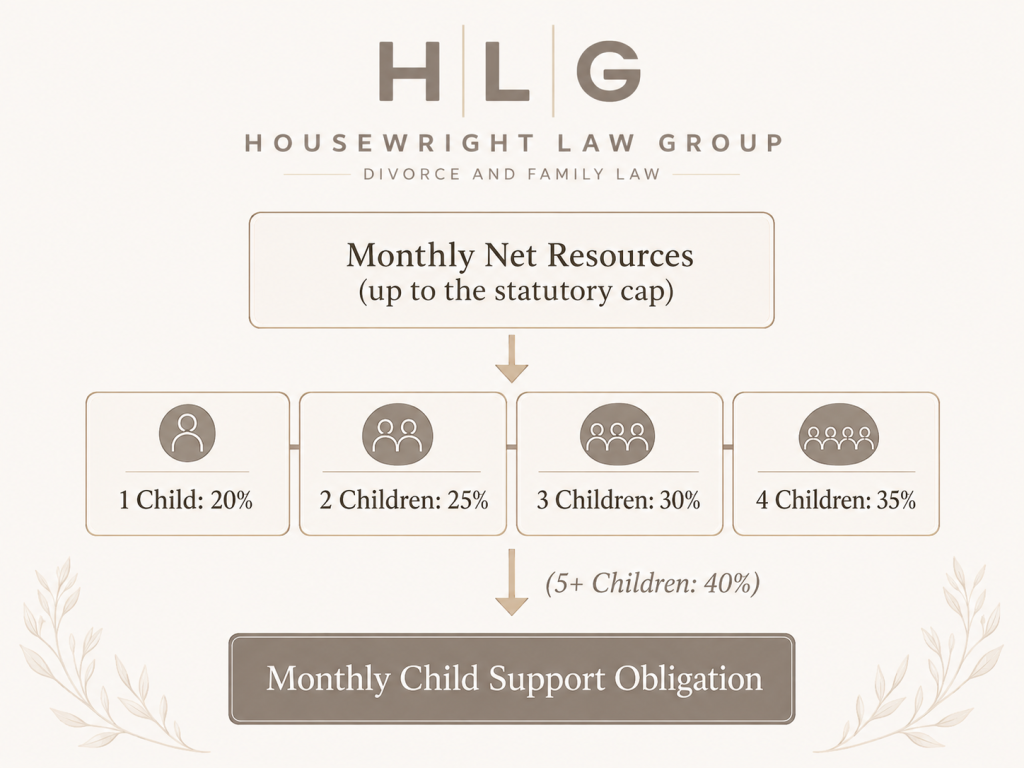
Texas Statutory Percentage Breakdown:
- 1 Child: 20% of net resources
- 2 Children: 25% of net resources
- 3 Children: 30% of net resources
- 4 Children: 35% of net resources
- 5 or more Children: 40% of net resources
Adjustments for Multiple Children in Different Households
If the paying parent has a legal duty to support children in another household (e.g., from a prior marriage or relationship), Texas law provides a reduced percentage schedule. For example, if an obligor is paying support for one child before the court and supports one other child outside the case, the applicable percentage drops from 20% to 16%.
The Statutory Net Resource Cap in Texas
Texas law recognizes that the guideline percentages should not apply infinitely to high earners. To maintain reasonable predictability, Texas Family Code Section 154.125(a) sets a texas child support cap on the maximum monthly net resources subject to the presumptive statutory percentages.
By statute, this cap is adjusted periodically by the state to reflect inflation. Under current guidelines, the statutory maximum net resource figure is $11,700 per month.
How the Cap Affects Maximum Monthly Payments:
When an obligor’s net monthly income meets or exceeds the $11,700 cap, the standard presumptive monthly child support amounts are:
- 1 Child (20% of $11,700): $2,340 / month
- 2 Children (25% of $11,700): $2,925 / month
- 3 Children (30% of $11,700): $3,510 / month
- 4 Children (35% of $11,700): $4,095 / month
- 5+ Children (40% of $11,700): $4,680 / month
Can a Court Order Support Above the Cap?
Yes. If the paying parent earns more than the statutory cap, the receiving parent can request “above-guideline child support.”
To secure child support above the cap in Collin County, the receiving parent must present evidence demonstrating the proven needs of the child. In Texas legal terms, “needs” are not limited to bare essentials (food, shelter, basic clothing); for children accustomed to a higher standard of living, needs can encompass private school tuition, specialized medical therapies, elite athletic training, tutoring, and extracurricular activities. However, the court will not order above-guideline support simply because the paying parent has substantial wealth.
Medical and Dental Support: Mandatory Additions
In addition to basic child support, Texas law mandates that every child support order includes provisions for medical and dental support.
- Health and Dental Insurance: The paying parent is generally ordered to provide and maintain private health and dental insurance for the child if it is available at a reasonable cost (not exceeding 9% of their annual gross income for medical, and 1.5% for dental).
- Cash Medical Support: If insurance is provided through the other parent’s employer, the paying parent is typically ordered to reimburse the cost of the child’s coverage premium.
- Unreimbursed Healthcare Expenses: Out-of-pocket medical costs (such as co-pays, deductibles, orthodontic care, prescriptions, and therapy) are almost always divided 50/50 between both parents.
Handling Self-Employment and Fluctuating Income in McKinney
In Collin County’s dynamic economic landscape, many parents are entrepreneurs, independent contractors, business owners, or executives with compensation packages tied to performance bonuses and stock options. Calculating net resources in these scenarios requires thorough financial analysis.
- Self-Employed Parents: Courts look at gross revenue minus ordinary, necessary business expenses. Non-cash deductions (such as depreciation or personal vehicle expenses written off for tax purposes) are often added back into gross income by family law judges.
- Intentional Unemployment or Underemployment: If a parent deliberately quits a job, takes a lower-paying position, or suppresses earnings to minimize child support, Texas Family Code Section 154.066 allows a Collin County judge to assess support based on the parent’s earning potential rather than their actual reported income.
Why You Need a McKinney Child Support Lawyer
Whether you are seeking fair support to maintain your child’s standard of living or ensuring that your financial support obligation accurately reflects your true earnings and legal deductions, accurate legal representation is crucial.
An experienced McKinney divorce attorney from Housewright Law Group will help you:
- Accurately analyze complex tax returns, business balance sheets, and compensation packages.
- Ensure all statutory deductions and multiple-family adjustments are properly applied.
- Advocate for or defend against above-guideline child support requests.
- Draft precise, enforceable support orders that minimize future conflict and ensure timely enforcement.
At Housewright Law Group, we provide authoritative, clear, and compassionate guidance to parents navigating family law matters in McKinney, Plano, Frisco, and across Collin County. We focus on protecting your rights while prioritizing the long-term well-being of your children.
Need clarity on your child support calculations or obligations? Contact Housewright Law Group today to schedule a confidential consultation at our McKinney office. Let us help you achieve a fair, balanced financial outcome for your family.